The Skill That Changes Everything
Vague In, Vague Out
Here's the single most important thing about working with AI: the quality of what you get back depends on the quality of what you put in.
If you ask a colleague "tell me about the project," you'll get a rambling answer because they don't know what you actually need. The same thing happens with AI. A vague prompt gets a vague response. A specific prompt gets a focused, useful one.
This isn't a flaw in AI. It's how communication works. The difference is that AI won't ask you clarifying questions the way a human would. It will just guess what you meant and give you something. That something might be brilliant, or it might be completely off base.
The skill you're building right now is prompting: giving AI clear, specific instructions so you get what you actually want, not what it guesses you want.
The Three Pillars of a Good Prompt
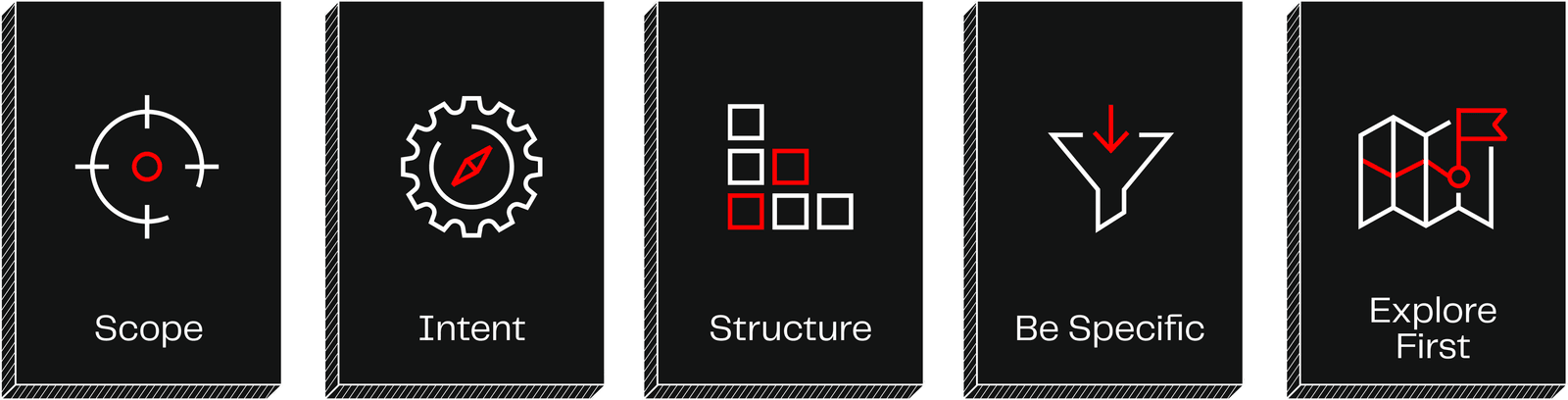
Every effective prompt has three elements. We call them Scope, Intent, and Structure:
| Pillar | What It Means | Example |
|---|---|---|
| Scope | Where should AI focus? What should it look at? | "Using USAspending.gov data for Lockheed Martin..." |
| Intent | What action do you want? Create? Summarize? Compare? | "...create an interactive vendor profile card..." |
| Structure | How should the output be organized? | "...showing total award amount, top 5 awarding agencies, business type indicators, and UEI in a scannable dashboard layout." |
Without these pillars:
Make me something about vendor research
AI guesses what to focus on, what to create, and how to organize it. You might get a paragraph of text. Or a quiz. Or a flowchart. Who knows.
With all three pillars:
Using USAspending.gov data for Lockheed Martin,
create an interactive vendor profile card.
Show total federal award amount, top awarding agencies
with dollar amounts, NAICS codes with descriptions,
business type indicators, and UEI. Make it scannable
and color-coded by spending tier.
Same topic, but you will get a completely different result.
Why Specificity Works
Think of words as having neighborhoods of related meanings. When you say "service," AI considers all the meanings: military service, food service, customer service, tech services. It has to guess which neighborhood you mean.
When you say "customer onboarding service," you've narrowed it to one neighborhood. No guessing needed.
You don't need to write more words. You need to write more specific words. Every specific word in your prompt narrows the range of possible outputs. That's what the pillars do: Scope narrows where, Intent narrows what, and Structure narrows how.
The Contrast Experiment
Split & Compare | ~3 minutes total | Split into two pairs: Pair A and Pair B.
New to pairing? Two people, one computer. The "driver" types while the "navigator" watches, thinks ahead, and catches mistakes. Switch roles frequently so both people get hands-on practice.
Time to prove this to yourselves. Each pair runs a different prompt in a new AI conversation, then you compare results.
Pair A - Start a new conversation and send this prompt:
Tell me about federal contracting
Pair B - Start a new conversation and send this prompt:
Explain how a contracting officer verifies vendor eligibility
before awarding a federal contract. What systems do they check
(SAM.gov, USAspending, exclusions database), what specific data
points matter most, and what happens if a step is missed?
In Your AI Assistant
Which tool should I use? Open gemini.google.com. Your machine should already be logged into a Gemini account set up by your facilitators, with access to Canvas for side-by-side interactive prototyping. If you get logged out, ask a facilitator for help signing back in. If Gemini isn't working, fall back to Claude.ai at claude.ai. Ask a facilitator for help if you have trouble with either tool.
Go to claude.ai and paste your prompt into a new conversation.
Go to gemini.google.com and paste your prompt into a new chat.
Regroup: Share your screens. What did Pair A get? What did Pair B get? Pair A probably got a wall of general information. Pair B got a structured, organized answer, exactly what you asked for. Same topic, same AI, completely different results. That gap is the Three Pillars in action.
Key Insight
Every word in your prompt narrows the possible outputs. The Three Pillars (Scope, Intent, Structure) are the principle behind why specificity works. Next, you'll learn a format that delivers all three pillars every time, so you don't have to think about them individually.